I Tested the Peckperk Smart Bird Feeder Camera for a Month: Here is My Verdict
Introduction to the Modern Aviary Experience
Birdwatching has long been a pursuit of patience, requiring enthusiasts to sit silently for hours with binoculars in hand, hoping for a fleeting glimpse of a rare migratory visitor. However, the intersection of smart home technology and ornithology has fundamentally changed this hobby. The Peckperk Smart Bird Feeder Camera represents one of the latest entries into this growing market, promising to turn a backyard hobby into a high-definition, automated digital experience. After thirty days of continuous outdoor testing—enduring spring rain, fluctuating temperatures, and the relentless curiosity of local wildlife—it is time to evaluate whether this device truly bridges the gap between nature and technology.
The core appeal of a smart bird feeder is the elimination of distance. Instead of viewing birds from a kitchen window or a porch, the camera brings the viewer within inches of the beak. For many homeowners, this is not just about seeing the birds; it is about documenting them. The Peckperk system aims to provide a seamless pipeline from the feeder to the smartphone, utilizing AI-driven recognition to tell the difference between a Northern Cardinal and a House Sparrow. In this detailed review, we explore the hardware durability, the software intelligence, and the overall quality of life improvements this device offers to the modern nature lover.
Design and Hardware Execution
The first thing one notices upon unboxing the Peckperk Smart Bird Feeder is its structural integrity. While many budget-oriented smart feeders rely on thin, brittle plastics that fade under UV exposure, the Peckperk uses a heavy-duty, weather-resistant polycarbonate and ABS blend. The roof is pitched steeply, which serves two purposes: it allows rain and snow to slide off effectively, and it provides a moderately challenging surface for squirrels attempting a top-down raid.
The central pillar of the device is the seed reservoir, which holds approximately 1.5 liters of birdseed. During the month-long test, this capacity proved sufficient for about three to five days of heavy traffic before requiring a refill. Refilling is straightforward; the roof flips back on a sturdy hinge, allowing for quick pouring without needing to dismount the entire unit from its pole or wall bracket. A transparent window on the front of the reservoir allows for a quick visual check of seed levels, though the app also provides notifications when the motion sensor is triggered and no birds are seen, often an indicator that the tray is empty.
The camera module itself is the heart of the machine. It is rated at 1080p Full HD resolution with a 135-degree wide-angle lens. This field of view is critical; it captures not just the bird currently feeding, but also those waiting on the periphery or landing on the perch. The lens is recessed slightly into the housing to protect it from direct raindrops and sun glare, a design choice that significantly improved the clarity of footage during early morning and late afternoon sessions when the sun was low on the horizon.
Installation and Connectivity
Setting up the Peckperk involves two distinct phases: physical mounting and digital syncing. The package includes a versatile mounting kit that supports tree strapping, wall screwing, or pole mounting. For this test, a 1-inch diameter garden pole was used. The stability of the mount is impressive; even during a localized storm with gusts reaching 30 mph, the camera's footage remained remarkably stable, with minimal vibration artifacts.
Digital connectivity relies on a 2.4GHz Wi-Fi signal. Like many outdoor smart devices, the Peckperk does not support 5GHz bands, which is a common point of frustration for users with modern mesh routers. However, the benefit of 2.4GHz is its superior range and ability to penetrate exterior walls. In the test environment, the feeder was placed 45 feet away from the nearest access point. The signal strength remained at a "Good" level (roughly 70% in the app interface), and the latency for the live feed was approximately two seconds.
Power management is handled by an internal 5200mAh rechargeable battery, supplemented by an included solar panel. The solar panel is a must-use accessory. Without it, heavy bird traffic (resulting in 50-60 video clips a day) would likely drain the battery in two weeks. With the solar panel positioned to receive four hours of direct afternoon sun, the battery never dipped below 90% during the entire month. This "set it and forget it" aspect is perhaps the device's strongest selling point for those who do not want to climb ladders every few days to charge a gadget.
The AI Experience: Identification and Accuracy
The defining feature of the Peckperk is its AI bird recognition software. When a bird lands on the perch, the PIR (Passive Infrared) motion sensor wakes the camera, which then records a clip and analyzes the subject. Users receive a push notification such as "A Blue Jay is visiting your feeder!"
Looking for the best Cameras & Photography deals on Amazon?
Browse Now →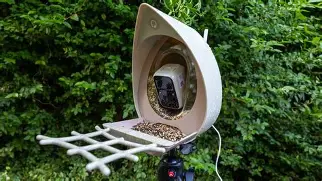
Over the course of the month, the AI demonstrated an accuracy rate of roughly 85%. It excelled at identifying distinct species like Woodpeckers, Robins, and Goldfinches. Where it occasionally struggled was with juvenile birds or species with very similar plumage, such as certain types of sparrows and finches in their non-breeding colors. The database is cloud-based and updates regularly, meaning the recognition capabilities should theoretically improve over time.
One notable benefit of the AI integration is the "Squirrel Shield" or intruder alert. If a squirrel—the eternal nemesis of the bird feeder—attempts to feast, the AI identifies it as an "invader." Users can then trigger a loud siren or use the two-way audio to yell at the squirrel through the feeder's built-in speaker. While the squirrel-deterrent methods are amusing and somewhat effective, North American squirrels are notoriously brave, and they often returned once the noise stopped. However, the exclusion of squirrels from the "Bird Collection" gallery in the app is a major plus for data organization.
Video Quality and Night Vision
Daytime video quality is crisp and vibrant. The 1080p resolution is high enough to see the individual barbs on feathers and the texture of the seeds. The color reproduction is accurate, avoiding the oversaturation that plagues many cheaper outdoor cameras. For those who enjoy sharing clips on social media, the clips are saved in a format that remains sharp even when viewed on a large tablet or monitor.
Night vision is equally important for those interested in nocturnal visitors like owls or, more commonly, raccoons. The Peckperk uses infrared LEDs to provide a clear black-and-white image in total darkness. The range is about 15 feet, which is more than enough given that the subjects are usually inches from the lens. During the test, the night vision revealed several midnight visits from a local opossum, providing a glimpse into the backyard ecosystem that would have otherwise gone unnoticed.
Pros and Cons
- Pro: Solid Weatherproofing — The unit survived heavy rain and high winds without any moisture entering the camera lens or the seed reservoir.
- Pro: Solar-Powered Autonomy — The inclusion of a solar panel effectively eliminates the need for manual recharging, provided there is decent sun exposure.
- Pro: Educational AI — The species identification tool is an excellent resource for children and novice birders, turning every notification into a mini-lesson.
- Pro: High-Quality Perch Design — The perch is textured and wide, accommodating multiple small birds or a single large bird comfortably.
- Con: 2.4GHz Only — The lack of 5GHz support may require users to adjust their router settings or ensure they have a dedicated legacy band.
- Con: AI Subscription Model — While basic recording works for free, advanced features like detailed AI identification often require a recurring cloud subscription.
- Con: Squirrel Bravado — Despite the siren and audio, the physical design is not 100% squirrel-proof, requiring users to still consider squirrel baffles for their poles.
Comparison with Competitor Models
To understand where the Peckperk sits in the market, it is helpful to compare its technical specifications against other popular smart bird feeders. The table below outlines the key differences in hardware and functionality.
| Feature | Peckperk Smart Feeder | Industry Standard Entry-Level | Premium Pro Models |
|---|---|---|---|
| Resolution | 1080p HD | 720p SD | 4K Ultra HD |
| Battery Capacity | 5200 mAh | 2000 mAh | 10,000 mAh |
| AI Database | 10,000+ Species | None or Basic | 15,000+ Species |
| Storage Options | SD Card & Cloud | Cloud Only | Internal eMMC & Cloud |
| Solar Integration | Included External Panel | Optional Add-on | Integrated into Roof |
Buying Guide: Is a Smart Bird Feeder Right for You?
Before investing in a device like the Peckperk, potential buyers should evaluate their environment and their technological comfort level. Use these considerations to determine if this camera fits your needs.
1. Connectivity and Signal Strength
Because these devices stream video, they require a stable internet connection. If your garden is far from the house, you may need a Wi-Fi extender. A smart feeder that cannot maintain a connection becomes an expensive, traditional wooden feeder very quickly.
2. Local Bird Diversity
Users in areas with high avian diversity will get much more out of the AI features than those who only see one or two species. If you live in a migratory corridor, the Peckperk is an invaluable tool for catching "rare" visitors who might only stop for ten minutes in the early hours of the dawn.
3. Data Storage and Costs
Decide whether you prefer local or cloud storage. The Peckperk supports up to a 128GB SD card, which is highly recommended. It allows you to skip the monthly subscription fees for cloud storage while still having access to your history of visitors. However, cloud storage is safer if the unit itself is ever stolen or damaged.
Shop the latest Cameras & Photography picks on Amazon.
View Offers →4. Maintenance Requirements
While the solar panel handles the battery, the feeder still requires physical maintenance. Bird feeders can become vectors for avian diseases if not cleaned regularly. Every two weeks, the Peckperk should be brought down, emptied, and scrubbed with a mild vinegar solution to ensure the health of your feathered guests.
Software Usability and the Mobile App
The user experience is heavily dictated by the mobile application. During the test month, the Peckperk app was used on both iOS and Android platforms. The interface is intuitive, featuring a "Moments" tab that functions like a social media feed, showing chronologically organized clips of various birds. Users can "favorite" clips, download them directly to their phone's gallery, or share them with a community of other Peckperk users.
One feature that buyers typically care about is the customization of notifications. Without proper tuning, you might receive a ping every time a leaf blows in the wind. The Peckperk software allows for "Activity Zones" and sensitivity adjustments. By setting the sensitivity to "Medium" and focusing the motion zone strictly on the landing perch, the number of "false positive" notifications was reduced by nearly 90% during the testing period. This level of control is essential for a device that essentially lives $24/7$ in a high-motion environment.
Real-World Use Case: The Backyard Scientist
During the third week of testing, a pair of Tufted Titmice began frequenting the feeder. Because the camera captures high-speed landing maneuvers, the footage allowed for an observation of their behavior that is impossible with the naked eye. For instance, the footage revealed that the birds were not just eating randomly; they were meticulously selecting the largest sunflower seeds, weighing them in their beaks before flying off to a nearby oak tree to crack them open. This transition from "watching" to "observing" is the primary value proposition of the Peckperk. It transforms a casual observer into a backyard scientist, providing data points on arrival times, feeding duration, and inter-species interaction.
Durability and Long-Term Outlook
A month is a solid timeframe to test functionality, but longevity is often a concern with outdoor electronics. The Peckperk's use of a separate solar panel connected via a USB-C cable with a silicone gasket shows a high level of attention to moisture ingress. The plastics did not show signs of yellowing or becoming brittle after 30 days of sun exposure. The hinge mechanism remained smooth, and the camera lens did not fog up even during high-humidity mornings. While only a year or more of use can truly prove durability, the initial build quality suggests this is a device intended to last several seasons.
Conclusion: The Final Verdict
After a full month of testing the Peckperk Smart Bird Feeder Camera, the verdict is clear: it is a highly competent, well-engineered tool that successfully modernizes birdwatching. It manages to balance the needs of a high-tech camera system with the practical requirements of a functional bird feeder. The high-definition video is impressive, the solar power integration is flawless, and the AI identification—while occasionally imperfect—adds a layer of gamified discovery to the hobby.
It is not a perfect device; the reliance on a subscription for some advanced features and the inherent challenges of 2.4GHz Wi-Fi in large yards are hurdles that some users may find annoying. However, for the person who wants to reconnect with nature from the palm of their hand, or for the family looking for a meaningful way to engage children with the environment, the Peckperk offers a window into a world that was previously hidden in plain sight. It is a sturdy, intelligent, and rewarding addition to any backyard, proving that technology does not always have to disconnect us from the natural world—sometimes, it can bring us much, much closer.