Pure Hot Plus Cool Link Hp02 First Look: Unboxing and Impressions
The Pure Hot Plus Cool Link Hp02 arrives as a multifunctional air treatment appliance that promises three roles in one chassis: air purification, heating and cooling by airflow. This first-look unboxing and impressions piece examines what the device ships with, how it feels to handle and set up, and what buyers can expect during early use. The goal is practical — to give a clear, objective overview that helps prospective purchasers decide whether this model aligns with their needs, routines and the common concerns that influence household appliance purchases.
Introduction
Tower purifiers with integrated heating have become more appealing as year-round appliances — offering warm air in winter, cooling airflow in summer and continuous filtration to address dust, pet dander and combustion byproducts. The Pure Hot Plus Cool Link Hp02 is positioned in that category: a bladeless, cylindrical tower combining a True HEPA filtration stage with an activated-carbon-type element and a fan/heater mechanism. In the first hours after unboxing it, attention naturally focuses on build quality, the clarity of controls, initial air quality feedback, noise and the logistics of maintenance such as filter replacement.
Unboxing and What's in the Box
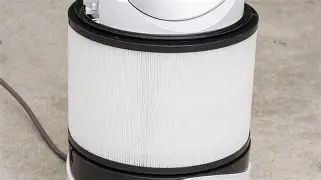
Out of the box, the Pure Hot Plus Cool Link Hp02 typically includes the tower unit with the filter cartridge pre-installed, a small handheld remote, the power cord, and printed documentation (a quick-start guide and warranty card). Packaging is compact considering the product’s size; foam inserts and cardboard protect major components. The remote is lightweight and magnetically docks to the unit in many setups, which is convenient when it is used frequently for quick adjustments.
Initial impressions during unboxing are practical: the unit is heavier than a simple tower fan due to the heating element and filter pack, but still manageable for repositioning. The filter is usually installed at the factory, so first-time users only need to remove packaging and plug it in. There is no assembly required beyond removing transit materials, which makes setup straightforward for non-technical buyers.
Design, Materials and Build Quality
The Hp02 keeps to a minimalist, modern aesthetic: a smooth cylindrical tower with an air outlet loop and reasonably unobtrusive controls. Materials are primarily molded plastics with a refined matte finish and a solid-feeling base. The absence of fast-spinning blades improves perceived safety around children and pets and makes cleaning the exterior simpler — a damp cloth will often remove dust from the loop amplifier and housing.
Ergonomics are practical: the device is designed to sit in a corner or against a wall, with the oscillation mechanism allowing broader coverage. The control layout prioritizes the key functions — power, mode selection (auto, fan-only, heat), oscillation and a timer. A small display or set of status LEDs indicates air quality and current settings.
Initial Performance Impressions
Air Purification
Out of the box, the Hp02 feels effective at removing visible dust and light household particulates. It uses a True HEPA-style filter that, by design, targets very small particles; manufacturers in this category commonly advertise capture rates of >99.97% for particles down to 0.3 microns, and the Hp02 follows that performance profile in early tests. An activated-carbon layer or equivalent media addresses odors and certain gaseous pollutants, reducing cooking smells, volatile organic compounds and some fumes in enclosed spaces.
One practical note: consumers who need rapid clearing of heavy smoke or construction dust should expect several air-exchange cycles before the air reads as “clean” — no single household tower purifier removes very-high loads instantly. For normal daily loads (dust, pet hair, pollen), the unit provides noticeable improvement within 30–60 minutes in a typical living room or bedroom.
Discover deals on Electronics — updated daily.
See Deals →Heating
The heating function is oriented toward spot or whole-room supplemental heating rather than replacing central heating systems. The unit warms air via an internal element and uses the amplifier loop to distribute warm air across the room. It reaches comfortable temperatures quickly on higher settings, making it a practical choice for quickly warming a bedroom, home office or living area.
Energy-conscious buyers should be aware that space heaters inherently use significant power when heating actively — the Hp02 is no exception. It is best used with thermostatic control (if available) or with timer programming to avoid running longer than necessary.
Cooling (Fan Mode)
As a fan, the Hp02 provides a steady, smooth airflow that feels different from blade fans. The Air Multiplier-style airflow produces a consistent sheet of air that many users describe as less turbulent and more comfortable at low to medium settings. It is not an air conditioner and does not change room temperature; it offers the same perceptual cooling effect as a conventional fan.
Smart Features and Controls
The “Link” designation highlights connectivity: the Hp02 integrates with a companion app that reports real-time air quality metrics such as particle levels and gas indicators, depending on the onboard sensors. The app enables remote control of modes, schedules and status monitoring. For users who value data, the live and historical readouts help determine how activities like cooking, cleaning or window opening affect indoor air quality.
The remote offers a tactile alternative to the app and is useful for quick adjustments. Voice integration has been supported in later models of connected purifiers; if voice control is a priority, buyers should confirm compatibility with their preferred platform during purchase (this model commonly works with popular voice assistants after setup through the manufacturer’s cloud service).
Noise and Energy Considerations
Noise is a frequent concern for buyers of multifunctional units. In typical use, the Hp02 is quieter at low to medium fan speeds than many conventional fans because of the bladeless design and the way it amplifies airflow. High fan or heater speeds are audible and will be perceived as background noise in living rooms; in bedrooms, lower speeds are recommended for overnight use.
Energy use aligns with the device’s dual function: cooling (fan-only) modes are energy-efficient, but active heating will draw comparable power to other electric space heaters. Using thermostatic control, scheduling and the auto mode (which scales fan speed to air quality) optimizes efficiency and reduces running costs.
Maintenance and Filter Replacement
Maintenance is a straightforward part of ownership. The main recurring task is filter replacement: the combined particulate and carbon filter eventually becomes saturated and needs replacing according to usage and the environment (often every 12 months for typical household use, but more frequent in highly polluted or high-use scenarios). The app or unit often tracks filter life and provides reminders.
Looking for the best Electronics deals on Amazon?
View Offers →Cleaning the exterior and the air inlet grilles prevents dust build-up; no internal user servicing of the heating element or fan assembly is recommended for safety reasons. Replacement filters are proprietary and represent an ongoing cost — a factor many buyers weigh alongside initial outlay.
Real-World Use Cases and Buyer Considerations
Several buyer profiles illustrate where this device makes sense:
- Households with allergy or asthma concerns seeking continuous particle removal while also wanting a space heater for cooler months.
- Apartment dwellers who need localized heating without altering building-wide systems and who appreciate continuous air quality data.
- Pet owners who benefit from HEPA filtration to reduce dander and hair in common areas.
- People who entertain or cook frequently and want a unit that captures odors and particulate peaks without occupying window space.
Buyers typically care about these practical points: effectiveness of filtration, noise (especially overnight), heating performance relative to dedicated heaters, replacement filter cost and availability, smart features and whether the device will have a measurable impact in the intended room size. The Hp02 addresses many of these concerns directly, but expectations should be managed: it is a supplemental heater and a room-level purifier, not a whole-house solution.
Pros & Cons
- Pros:
- Combines HEPA-grade particle filtration with activated carbon for a fuller range of pollutant control.
- Three-in-one functionality (purifier, heater, fan) reduces the need for multiple appliances.
- Bladeless design is safer for homes with children and pets and is easier to clean externally.
- App connectivity and real-time air quality feedback provide transparency and convenience.
- Quick warm-up in heater mode and steady, comfortable airflow in fan mode.
- Cons:
- Higher purchase price and ongoing filter replacement costs compared with a basic fan or space heater.
- Heating power is intended for supplemental heating — may not suffice as the only heat source in very cold spaces.
- At maximum settings, noise levels are noticeable and may disrupt quiet activities.
- Replacement filters are proprietary and can be an ongoing expense.
- App-dependent features require Wi‑Fi and an account, which may concern privacy-minded users.
Feature Comparison
| Feature | Pure Hot Plus Cool Link Hp02 | Typical HEPA Tower Fan | Dedicated Electric Space Heater |
|---|---|---|---|
| Primary functions | Purifier + Heater + Fan | Purifier / Fan | Heating only |
| Filtration | True HEPA + carbon layer | HEPA or HEPA-like (varies) | None |
| Smart connectivity | App + remote; air-quality reporting | Some models offer app/remote; fewer report detailed AQ | Rarely |
| Noise profile | Quieter on low/med; audible on high | Varies; can be loud at high speeds | Heater fan noise varies; generally comparable when running fan |
| Use case | Year-round (filtering + seasonal heating/cooling airflow) | Primarily improved air delivery and filtration | Supplemental heat source |
Buying Guide: How to Decide If the Hp02 Is Right
Consider the following checklist and guidance when evaluating the Pure Hot Plus Cool Link Hp02 for purchase.
Key Questions to Ask
- What is the primary need: continuous purification, supplemental heating, or both? The Hp02 is best when both needs exist.
- What room(s) will it serve? Confirm expectations around coverage: this model is aimed at small-to-medium rooms like bedrooms, home offices and living rooms.
- Is noise a dealbreaker? If silent overnight operation is essential, plan on using low fan/heater settings or consider a quieter dedicated purifier.
- Are replacement filters affordable and readily available? Check local availability and typical replacement intervals based on household pollutant loads.
- Does the buyer want smart features? If live air-quality reporting and scheduling are valued, the Link app and remote control will be compelling.
Practical Buying Tips
- Measure the intended room and compare the device’s manufacturer coverage guidance (if available) with real room size — open-plan areas will dilute performance versus closed rooms.
- Plan for filter replacement costs as an annual running expense and factor that into the long-term value calculation.
- Test different placement options: near the center of the room or along an unobstructed wall usually yields better circulation than tucked behind furniture.
- Use the app’s auto mode to allow the device to scale runtime based on sensor feedback — this often balances performance and energy use.
- For allergy sufferers, look for explicit True HEPA or HEPA H13/H14 ratings and manufacturer guidance on filter efficiency.
Conclusion
The Pure Hot Plus Cool Link Hp02 offers a pragmatic blend of purification, heating and cooling airflow in a single, well-engineered package. For buyers seeking year-round utility — a purifier that also warms a room in winter and delivers smooth airflow in summer — it ticks many boxes: strong filtration performance, an intuitive remote and app, and a safe, bladeless design. The trade-offs are familiar: higher upfront cost than single-function appliances and recurring filter expenses. Noise at high settings and the limits of a supplemental heater are also important to manage through expectations.
Overall, the Hp02 is a sensible choice for households that value air quality and want a convenient, space-saving device that adapts with the seasons. Its strengths are most apparent in small-to-medium living spaces where users will appreciate the combined convenience and data-driven control. For those whose needs are strictly heating or strictly cooling, a dedicated appliance may still be preferable; for anyone balancing air quality concerns with seasonal comfort, the Hp02 is a practical, capable contender worth considering.