Ugreen Nexode 500W 6 Port Charger Specs, Features, and Value: Is it worth the price tag?
Introduction
The Ugreen Nexode 500W 6-Port Charger arrived in a market crowded with multiport GaN chargers promising to replace a tangle of power bricks. Its headline figure — 500 watts of total output across six ports — immediately positions it as a desktop power hub aimed at power users, creators, and small workspaces. This article examines the Nexode’s specifications and real-world behavior, compares it to more typical multiport chargers, and offers a practical buying guide so readers can decide whether the Nexode’s capabilities justify its cost.
What the Nexode 500W promises (official overview)
The Nexode is a GaN-based desktop charger that consolidates six charging ports into a single enclosure. Key points of the official specification set include:
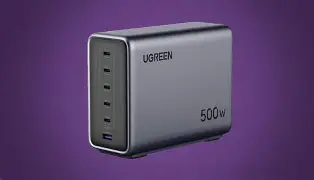
- Total output: 500W shared across all ports
- Port layout: five USB-C ports and one USB-A port
- Highest single-port capability: one USB-C port supports up to 240W (PD 3.1 EPR)
- Other USB-C ports: each rated up to conventional laptop wattages (commonly up to 100W depending on distribution)
- USB-A: a fast-charging legacy port useful for older phones and accessories (around 20–22.5W max)
- Safety: multiple protections for over-current, over-voltage, over-temperature, short-circuit, and tip-over; manufacturer cites multi-layer protection
- Compatibility: PD 3.1/3.0/2.0, PPS, Quick Charge, and other common fast-charging protocols
- Physical: a desk-oriented enclosure with an integrated power cord and a relatively large, heavier footprint compared with travel GaN bricks
Detailed product analysis
Performance and power distribution
Where the Nexode stands out is in raw aggregate power. A total of 500W is far higher than typical consumer multiport chargers (many of which range from 65W to 200–200+W). That headroom enables simultaneous charging scenarios that smaller chargers simply cannot support.
Official power distribution logic is dynamic: the charger negotiates each device’s power needs and apportions the 500W total accordingly. Typical documented configurations include a single 240W-capable USB-C port (for high-wattage laptops), four additional USB-C ports that can each deliver up to conventional laptop rates when there is available budget, and an older USB-A port for phones or accessories. A realistic all-ports example is roughly:
- USB-C1: 240W
- USB-C2–C5: around 60W each if C1 consumes full 240W
- USB-A: ~20W
This example adds up to approximately 500W and illustrates the trade-off: the more power handed to a single port, the less remains for the others. For most households and small offices the Nexode will keep laptops, tablets, phones, and accessories topped up without resorting to extra bricks.
Compatibility and protocol support
Support for USB Power Delivery 3.1 (including Extended Power Range for >100W profiles) is essential to reach 240W on a single port. The Nexode also supports PD2/3, PPS and common proprietary protocols, so it's broadly compatible with modern phones, tablets, and laptops. Buyers should be mindful that to use the 240W capability they must pair the charger with a certified 240W USB-C cable; standard USB-C cables and older USB-C PD cables are not guaranteed to carry that voltage and current safely.
Heat, efficiency, and GaN advantages
GaN (gallium nitride) technology is a substantial part of this design. Compared with silicon-based chargers, GaN allows higher power density and improved efficiency. In a 500W desktop unit, heat management is still a primary design challenge; Ugreen’s approach uses multiple GaN stages and thermal controls. Expect the Nexode to run warm under heavy multi-device loads but remain within safe operating temperatures thanks to thermal throttling and multiple protection layers. Users should place the unit on a well-ventilated surface and avoid enclosed shelving when delivering sustained high power.
Build quality, ports, and ergonomics
The Nexode is a desk-first product: it is larger and heavier than travel chargers and is intended to stay plugged in. The six-port layout puts five USB-C ports and one USB-A on the front face for convenient access. The integrated power cord and solid-feeling enclosure echo a product designed for permanence on a desk rather than briefcase portability. The weight and footprint pay off in durability and cooling area but make the Nexode impractical as a travel stash.
Real-world cases and user scenarios
Buyers often imagine the following real-life setups that a 500W hub can handle:
Find top-rated Mobile Phones products at great prices.
See Deals →- A home office: charge a 16-inch laptop (100–240W range depending on model), a tablet, two smartphones, and accessories like earbuds or a power bank — all simultaneously, without multiple bricks.
- A content-creator desk: supply power to a laptop, camera battery chargers, mobile devices, and LED lighting simultaneously during extended shoots or editing sessions where reliability matters and cable clutter is a concern.
- Shared space or small meeting area: multiple attendees can top up phones and laptops from a single hub during a meeting or co-working session.
- Not ideal for travel: its size and weight, plus reliance on high-wattage local mains input, mean the Nexode is best used as a fixed desk unit rather than a travel charger.
Pros & Cons
Pros
- Massive 500W aggregate output covers demanding multi-device setups
- One USB-C port supports up to 240W for the newest high-wattage laptops
- Five USB-C ports plus a USB-A port provide excellent device density
- GaN-based design increases efficiency and reduces heat compared with older silicon chargers of similar power
- Comprehensive safety protections and dynamic power distribution
- Reduces power brick clutter for desk-centric users
Cons
- Large and relatively heavy — not suitable for frequent travel
- High-wattage charging (240W) requires a certified cable sold separately
- When one device takes a large share of power, other ports will be limited
- Premium capability comes with a premium price relative to single- or lower-watt chargers
- Potential for noticeable warmth under prolonged full-load conditions
Comparison: Nexode 500W vs typical multiport chargers
The following table contrasts broad categories to help contextualize the Nexode against more common multiport offerings. This is a feature-focused comparison rather than a brand-by-brand price contest.
| Feature | Ugreen Nexode 500W (6-port) | Typical High-end Multiport (100–200W) | Portable Travel GaN Brick (65–140W) |
|---|---|---|---|
| Total output | 500W | 100–200W | 65–140W |
| USB-C ports | 5 | 2–4 | 1–3 |
| Highest single-port | 240W (PD 3.1 EPR) | Up to 100W | Up to 140W (select models) |
| USB-A ports | 1 | 0–2 | 0–1 |
| Typical use | Desk hub for multiple laptops/phones/devices | Desktop & travel hybrid for a couple devices | Travel & single laptop with phone |
| Portability | Low (desk unit) | Medium | High (very portable) |
| Price relative to category | Premium | Moderate–premium | Moderate |
Buying guide: what to consider before purchasing
Large multiport chargers are not purely impulse buys—matching device needs and expectations matters. The following checklist helps determine whether the Nexode is a suitable choice.
1. What devices and power profiles are required?
List each device’s maximum charging wattage. If a user has a laptop that needs up to 240W (some high-end gaming and workstation laptops can), the Nexode’s 240W port is attractive. For users who only need to charge phones and a single laptop under 100W, a smaller multiport charger may be more cost-effective.
2. How often will multiple devices be charged simultaneously?
Households, shared desks, or creators who routinely top up several devices simultaneously benefit most from a high aggregate wattage. If simultaneous charging is rare, the Nexode is overkill.
3. Cable and accessory considerations
High-watt charging requires the right cable. For >100W charging, use USB-C cables rated for the intended wattage (for PD 3.1 EPR up to 240W, a certified 240W cable is required). The charger does not automatically include those specialized cables. Also confirm that devices accept the negotiated power profiles (some older laptops use proprietary bricks).
4. Desk footprint and ventilation
The Nexode is a desk appliance. Ensure adequate surface area and airflow. Avoid placing it inside closed cabinets or under materials that trap heat.
5. Safety features and certifications
Look for multi-layer protections, temperature-management systems, and relevant safety certifications that match local regulations. Those features reduce risk with high aggregate wattage.
6. Warranty and support
Higher-cost power hardware should have decent warranty coverage and accessible support channels. Confirm warranty length and how warranty service is provided in the buyer’s region.
Shop the latest Mobile Phones picks on Amazon.
View Offers →7. Price vs value for your use
Consider total cost including necessary certified cables. For users who replace several bricks and value a tidy desk and consolidated power, the Nexode may justify its premium. For the occasional dual-device user, a cheaper multiport charger is often a better value.
Practical tips for safe and optimal use
- Use certified cables: for full 240W, purchase a certified 240W USB-C cable and verify the cable’s rating before relying on the highest wattage.
- Distribute loads intentionally: when possible, avoid full 240W on one port if several other devices need simultaneous charging at high rates; balancing reduces heat and throttling.
- Place on a flat, ventilated surface: maintain airflow around the charger and avoid stacking other objects on top.
- Check device compatibility: some laptops and devices still prefer manufacturer-supplied bricks or have unique power negotiation quirks — test with lower-risk devices before relying on the Nexode for critical workflows.
- Monitor temperatures under heavy use: brief warmth is normal; sustained high heat indicates poor ventilation or a problem.
Value assessment: who should consider the Nexode?
The Nexode makes the most sense for:
- Users who operate multiple high-wattage devices from a single desk (e.g., a laptop, a backup laptop, a tablet, and several phones).
- Content creators and small teams who want to reduce power-brick clutter and charge multiple devices reliably during work sessions.
- Home offices where a permanent, powerful charging hub is more convenient than multiple chargers.
It makes less sense for:
- Frequent travelers who need a compact, light charger for a single laptop and phone.
- Users who only need to charge one device at a time or rarely have more than two devices concurrently charging.
- Shoppers with a strict budget who can accept smaller convenience for much lower cost.
Conclusion
The Ugreen Nexode 500W is a striking offering that rethinks the power brick landscape for desks and small shared spaces. Its 500W total output and a 240W-capable USB-C port make it one of the few consumer chargers that can replace multiple laptop bricks and phone chargers simultaneously. For power users — creators, small teams, or anyone who needs to keep several high-watt devices charged at once — the Nexode offers a compelling combination of convenience and capability.
However, that capability comes with trade-offs: size, weight, the need for certified high-wattage cables, and a price tag that places it firmly in the premium segment. Buyers should assess whether their day-to-day charging demands make full use of the Nexode’s aggregate power. If the answer is yes, the Nexode simplifies a complex charging setup and reduces clutter. If the answer is no, many smaller multiport GaN chargers will meet the needs at lower cost and with greater portability.
In short, the Nexode is worth its price for the right user: those who value consolidated, high-capacity charging at a desk and will consistently take advantage of its high-wattage distribution. For everyone else, a less ambitious multiport charger will usually deliver better value.